Monday, October 7, 2013

Review: These Broken Stars

A cover that is actually 100% true to an actual scene in the book! Le gasp!
*I received a copy of These Broken Stars from Disney Book Group in exchange for an honest review.

Summary: Lilac is an heiress, a socialite, the privileged daughter of the protective founder of a company that explores and develops space. Tarver is a war-hero soldier from a modest but close-knit family, who is all but unaware of the ramifications of smiling at the pretty redhead across the room. When the spaceship in which they're hurtling through space suddenly breaks down and everyone aboard must flee to their lifeboats ("pods") a la Titanic, Lilac and Tarver end up in the same pod, crash-landing on a seemingly abandoned but strangely developed planet. They're the only humans in the entire world, but strange things begin to happen and secrets about Lilac's father's company are slowly revealed while the two of them struggle to survive.

Review: You guys, this book is what Beautiful Creatures should have been. What?, you're saying to me, Beautiful Creatures is not science fiction.
Yes, I know. That's not what I'm talking about. I'm talking about the written-by-two-authors-with-two-equally-important-protagonists thing. This book does it right. Why, you ask? Because Amie Kaufman and Megan Spooner understand that with two authors and two leads, it makes so much more sense to tell the story from two points of view. I don't know how they broke it down, if one author wrote Tarver and one author wrote Lilac, or if they split it a different way, but I don't care-- because it's obvious that they worked together on this.
The chapters alternate between Tarver's point of view and Lilac's, but you don't have that sense of constantly being jolted between the two, right when you were getting into the flow of one character's narration. It's done cohesively, and the scenes are written such that it makes sense for Tarver to narrate this scene and for Lilac to narrate that scene, or vice versa. There are no chapters where you go, man, I wish I were in the other character's head for this part, the way I did for oh, 95 percent of Beautiful Creatures, wherein every chapter is all-Ethan-all-the-time despite the fact that Lena is by far the more captivating character.
But I digress.
These Broken Stars is not your average science fiction novel. It sparkles. It's sparkly. I don't know how else to describe it. And, boys, if you're reading this, stop making that face. Sparkles do not a girly book make. There are spaceships and aliens and soldiers and vast amounts of sarcasm here, too. The girl in the dress on the cover is just that: a girl in a dress. I've never known a boy to hate girls in dresses in real life, so I'll never understand why they avoid books with girls in dresses.
The characters in this book are few, I will say, but they are vivid and dynamic and they have so many facets that you don't need any more characters. Lilac is privileged and occasionally shallow, yes, but she is also whip-smart and fiercely protective of the people she loves. She knows more about the technology of her world than just about anyone, and she's an equal match for Tarver, the war hero who knows more about survival than just about anyone. Tarver is sarcastic; he doesn't respond well to stupid questions, and his mental quips about Lilac will get you through the first half (maybe less) of the book while the two still mostly dislike each other.
My favorite thing about Lilac is that she could have been entirely selfish, having been raised in a privileged environment where she was coddled by everyone who dared to get to know her, but she isn't. She is, for the most part, selfless-- and not in that Bella way that makes her entirely useless. She has intelligence to back up her selflessness; when she needs to help someone, when for any reason someone is counting on her for their survival, she knows how to handle the situation. Girlfriend gets things done.
My favorite thing about Tarver is that he can be both amusing and serious. After Lilac treats him like he doesn't deserve to breathe the same air as her, he thinks, "Duh, I should have known," but then he thinks about it some more and decides she does not have the right to treat him that way. He's respectful to her, but condescendingly so, which I love. Not knowing her motivations for her cruelty, he has every right to mentally complain and make jokes about being stuck with this girl on a strange planet with nobody else around. But at the same time, he expertly balances the fact that she saved his life before they got here with the fact that now it's up to him to keep her alive too.
As for the plot, well, honestly there's not much of it. It's a subtle thing that creeps along and builds tension and then explodes in your face (it's a contained explosion), but for the most part of the book it's a whisper in your ear. It's something that demands your attention, but you can't really say why. All you know is that you want to keep reading. And the romance? Not really a slow-burn, but not really an insta-love situation either. Tarver and Lilac just work. They're a good team, and once they get past the I-hate-you, I-hate-you-more stage, it's actually endearing that the majority of the book focuses on their relationship.

I don't know where the next book is going from here, but I'm sure it will take me with it. I hope it shines with the same subtle intensity as this one, and I hope we get some more awesome characters like Tarver and Lilac. Sparkle on, Starbound series.
★★★★½

Saturday, September 28, 2013

Review: Never Fade by Alexandra Bracken

I received an ebook of Never Fade from Disney
Hyperion in exchange for an honest review.
Let me explain to you why I hate reading on my e-reader. Well, one of the many reasons. The biggest reason right now.
You cannot tell when the book is almost over. Sure, there is a little progress bar. But do you ever look at it? No.
You get to the last sentence, and try to turn the page, and what do you find?
Nothing.
Oops. The book is over. You have to wait another year to find out what happens next-- "next" meaning after you yell "AGCHGHH?!?" eighteen times and forcefully throw your expensive e-reader onto a hopefully cushioned surface.

Never Fade begins six months after the end of The Darkest Minds, and Ruby has been training with the Children's League since then. She's not sure she's on their side yet, but she's doing what she can to make sure they're on her side. Which brings me to my first point: Ruby Daly. You could read this book for her character development alone, and still feel fulfilled. Remember when Ruby was afraid of her power? No more. Remember when Ruby carefully schooled her face into a mask of indifference because she was afraid of being noticed? No more. (Now her indifferent mask is meant to keep people out, because her feelings are none of their goddamn business.) Her nickname around the League is Medusa, and she's earned it. Six months without anyone who loves her, or contrarily anyone who would kill her for being Orange, have produced a Ruby Daly who has no more soft edges.

Next up: Plot. There is so much more action and drama in this book. In The Darkest Minds, we had a plot that was kind of like one of those walking conveyor belts at large airports-- it was a smooth power-walk from one point to the next, without many off-the-charts spikes in action or drama. Never Fade is more like a rollercoaster: so fast and wild that you come out of it with wind-blown hair and a mild headache. But it's... the good kind of headache?

Moving on to... new characters! These two new characters in particular could have been thrown at me, they could have been lifeless nobodies whose sole purpose was to fill the void left by missing characters from Book 1, but they were not. Vida jumped out in front of me, told me we were going to be friends but I better not step on her toes, and then walked me to my car, threatening creepy dudes with profanity and knives. Jude walked up next to me, introduced himself, talked about his fears but tried to make it seem like he wasn't afraid, and followed me to my car like a loyal puppy dog. They're not Chubs and Liam, but neither are they replacement-Chubs-and-Liam*. You can't help but love them.

*No, I will not disclose whether Chubs and/or Liam are in Never Fade. Sit down.

The writing even improves on the first book, with practically genius tension-building and tension-diffusing both. Naturally comedic dialogue at all the right moments and heartfelt or strategic dialogue everywhere in between-- it's part of what keeps this book so consistent with the first one, when so much of the plot and cast are so completely different.

I have to say the only thing I did not like about this book was that there was so much drama that was not character-centric. Certain characters and relationships weren't given nearly as much attention as would have satisfied me, given the setup from Book 1. It was so focused on the action and all the different conflicting groups of people that the more personal touches, which I loved so much about The Darkest Minds, faded into the background. But at the same time, this made it exponentially more effective when the focus was on the personal elements-- when the characters would really step into their roles of who they have to be for each other, rather than who they have to be for everyone else (there was ONE LINE that turned me into a flailing, squealing mess). I just wish it could have happened more often.

Finally, back to the end. I have to talk about the end. I won't tell you what happens, but I will tell you it ends even more suddenly and torturously than the first book did. But instead of leaving you with that "NO THIS IS NOT OKAY" feeling, it leaves you with a sly grin on your face and the feeling that maybe, just maybe, this time the upper hand is just waiting for your beloved characters to grab it. It's almost theirs.
★★★★☆
Four stars for now, but I get the feeling this is going to end up being one of those books that keeps on poking at my thoughts until I give it five stars.

Friday, September 20, 2013

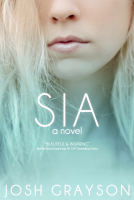
Review: Sia by Josh Grayson

I received this book from the publisher in exchange for an honest review.
So, spoiled rich girl lives a life of selfishness and bullying, putting other people down in order to raise herself up. Girl goes through the trial of a lifetime and realizes the error of her ways, serving penance for the way she has treated those around her. This is not a new story, but it could have at least been interesting. It could have been a story worth telling. Sia could have been a character I grew to care about.
Unfortunately this book is full of near-misses for me. I can get on board with the bully-learns-her-lesson trope, if the bully actually does learn her lesson. Sia does not. Sia didn't need to learn anything; she woke up one day an entirely different person. The only thing that showed her the error of her ways was looking at her previous life through the eyes of a stranger-- eyes that already knew right from wrong.
I could have dealt with this, even, if the book had given New!Sia any glimpses of why she became the horrible person that she apparently had been before, if New!Sia could have said, "Oh, I understand why I acted that way, but really I think I should be a better person anyway." That would have been acceptable character growth. But that didn't happen! Not only was the explanation of Sia's memory loss anticlimactic (it was basically a "Yeah, that happens sometimes" situation), but we did not even get an explanation for what made Old!Sia the supposed worst person, like, ever. There was nothing to connect me to either New!Sia's I-spent-a-couple-weeks-homeless-and-now-I'm-a-champion-for-the-masses attitude or Old!Sia's money-makes-people-superior attitude.
And I've already forgotten the love interest's name, so you can see how much of an impression he left on me. Not only this, but the rest of the characters all around are cliched to the point where I caught myself actually rolling my eyes. The only black character is a wizened homeless woman, the only Latina is Sia's rich family's housekeeper, and every rich person in the book is-- you guessed it-- white. Oh, except for the beautiful Asian supermodel, of course.
Combine all of this with the fact that there is no sustained tension in the story-- every source of potential conflict plays out within a chapter or two-- and a romance that is probably supposed to be cute but hovers dangerously close to annoying teenaged insta-love, and you'll be glad this book is a short one. Had it been about 50 more useless pages, I would have closed this off in the DNF section of my brain halfway through.
Usually when I write a scathing review of a book, I like to leave off with something positive (like, "I hated the characters and the plot, but the writing was beautiful"), but the only positive thing I can say about Sia is that I was able to finish it. The writing was unimpressive and frankly too juvenile for the Young Adult genre, so I can't even use that to soften the blow. But I did finish. It was a breeze of a book, simply because there was so little substance to it.
The takeaway: Don't bother.

Tuesday, September 3, 2013

Review: Fangirl by Rainbow Rowell

Rainbow Rowell gets it. Whatever it is, she gets it.
With Eleanor & Park, the consensus was clear: Rainbow is a force to be reckoned with, not in just contemporary YA, but YA in general. (And she's super nice, too). Her characters are nothing short of real people living inside your head, kindred spirits in whom you recognize a part of yourself.
I loved Eleanor & Park.
I am in love with Fangirl.
The reason for this, I think, is because I identify so much more with this book, this protagonist, than I ever did with Eleanor, which is set before I was born, in a place nothing like where I grew up. That's not to say that identifying with a character is a necessary step to falling in love with a book, but in this case, I'm pretty sure it is exactly why I was able to choose a favorite. Because it's not just Cath's personality that reflects me back to myself-- it's her life, reflecting mine back to me, showing me my own decisions in a different light.
Cath is a fangirl. A nerd. She would rather sit alone in her room and obsess over fictional characters than go out and be part of a scene where she doesn't think she belongs. Possibly she has social anxiety. Most of her friends are on the Internet. She hates change. She has a twin sister who's more socially involved than she is, but who's always been her built-in best friend. Cath loves to write, and she's good at it, but she has oodles of self-doubt about whether she can go anywhere with it. She doesn't think she can measure up to her favorite author because she can't create her own worlds, so what's the point? She'll stick to fanfiction, thank you very much.
Okay, now take out Cath's name in that last paragraph and replace it with mine. It is all still true. It might still be true if you replace it with your name (except maybe the twin part). Maybe not.
But the best thing about all of this? Fangirl does not talk down to me or tell me that there's anything wrong with the way I am. The way Cath is. Yes, she learns a bit about coming out of her shell and believing in her own abilities, but not once is she ever ashamed of being a fangirl. The only reason she ever keeps it to herself is because other people don't understand, and she doesn't want to have to explain it-- and speaking of explaining it, the book itself does a pretty good job of explaining the fangirl lifestyle. Why it means so much to have characters and stories in our lives that we can escape to, that can help us through when real life just doesn't cut it, that are loved by complete strangers who in turn become some of our best friends because we share something with them that few other people understand. 
The synopsis for the book asks, "Is she ready to start living her own life? And does she even want to move on if it means leaving Simon Snow behind?" Which is annoying because it suggests that the book argues Cath has to move on from fandom in order to live her own life. But she already is living her own life. She has her own fans, and people who love her because of how passionate she is about her story of choice, Simon Snow. All she really has to do is learn balance (it is the meaning of life, you know. Just ask Barry Lyga).

Anyway, I don't know if people who are not fangirls/fanboys will be this excited about Fangirl (like, maybe if you don't know what the words "canon" or "shipper" mean, you should familiarize yourself first). My coworker gave it to me specifically because she saw me in it, too, and I know that she actually liked Eleanor & Park better. I feel like Rainbow's books are more dependent on personal reactions than a lot of other books, because they're so good at evoking that sense of "Yes, I know exactly what this feels like."
I guess what I'm saying is that I recommend this book to everyone, but I only guarantee you'll love it as much as I did if you're... well, one of my Internet friends.
★★★★½

Saturday, August 10, 2013

Review: The Beginning of Everything by Robyn Schneider

I absolutely love this cover.
Wow. I found this book in the small pile of galleys on the small table in our small kitchen at work, and picking it up was the best impulsive decision I can remember making in a while. I'd been looking at the pile, not really expecting to find anything because of how few books were in it and how few titles I recognized. Strangely, I didn't recognize this one either, but I read the back and gave it a shot.

Sorry, I'm doing that annoying thing where I give you my personal history with a book instead of just diving directly into my review. But you have to understand that I had no preconceived notions about this book when I picked it up, and no idea-- apart from the blurbs on the back-- if anyone else had liked it either. Sometimes I'm afraid that other people's thoughts on a book influence my own, so I can safely tell you that these are my thoughts and mine alone.

First off, I was hooked from the very beginning. Even before the severed head part (apparently the former title of the book was "Severed Heads, Broken Hearts" and honestly I don't know why they decided to go with The Beginning of Everything, but hey. I guess some people don't want to read a book that might be about severed heads?). Ezra's tone was simultaneously satiric and tragic, at once full of scorn and wonder, and I knew I was done for. Or, more specifically, my skin was done for, because I started the book outside by the pool and did not go inside until 233 pages and one sunburn later.

This is definitely a character-driven book, which is how I like them. Don't get me wrong, things do happen, but they might not be the interesting sorts of things to increase the heart rates of plot-concerned people. The three main characters, Ezra, Toby and Cassidy, are the outcasts of the school, but instead of being the outcasts who fall together by default, they have actual relationships with each other. Toby and Ezra were childhood best friends, until Toby's unfortunate encounter with a severed head; Toby and Cassidy know each other from debate team events; and Ezra and Cassidy develop a natural relationship that stems from their having similar outlooks and senses of humor. The Great Gatsby is referenced several times throughout the book, and though Nick Carraway is never mentioned by name, it's obvious that Ezra fancies himself the Nick Carraway of this story. He's telling it as if it's someone else's story, but it's all his. It's a story about him finding himself, and realizing the type of person he does not want to be. He considers himself an onlooker to the reckless behavior of his jock friends, but at the same time can't seem to escape them until he really wants to-- and then he only looks back in the telling of the story, not in the desire to relive it.

Toby is the comedic relief character, but also kind of the heart of the story. He's the one who's there for Ezra, even though Ezra left him behind, and even though Ezra is kind of a jerk sometimes. He shows Ezra how to be a good friend and how to escape the sillage of the past, all while wearing bow ties (he's a Whovian) and making nerdy jokes. Nerdy jokes: the quickest way to my heart.

Cassidy is where the story becomes a little less Great Gatsby and a little more Looking for Alaska. Ezra is convinced he's in love with her, but Cassidy is convinced he's in love with his idea of her. Where Alaska talks about escaping the labyrinth, Cassidy talks about escaping the panopticon. Her tragedy is entwined with Ezra's, just as Alaska's tragedy becomes Pudge's. She's a thinker; she has grand ideas about life, but she has a long way to go before she figures it all out-- Ezra sees her mistakes for what they are, just as Pudge is finally able to answer the question that Alaska was never able to answer, after it's too late for her.

Now, let's talk about the similarities between this book and Looking for Alaska for a moment, because I have the feeling a lot of people are going to lean toward the negative in their reviews because of it. But here's the thing: they are very, very similar, but they are not the same. They're structured similarly, and they both have the beautiful, sad girl (not beautifully sad, mind you. Neither of these books argue that sadness is beautiful, so don't start), and the references to quotes from historical/literary figures, and the questions/answers about grief and forgiveness and life in general. Heck, the last paragraph of Beginning was so reminiscent of the last page of Alaska I almost felt like there has to be some kind of outline that Robyn Schneider and John Green both used*. But the fact that the two books are so similar does not make either of them any less worth reading. Looking for Alaska is one of my favorite books, so why wouldn't I want to read another book like it? I'm not going to take away points in my review because the book reminded me of another book I loved. That's ridiculous, and if you do that, ask yourself if you're holding other books to the same standard.

*and I have no right to comment on the similarities between the authors/vloggers themselves, or whether it means that one is trying to imitate the other, though some people will probably try to do so. Both are brilliant writers and that's all that matters to me.

Other elements that set this one apart-- not just from Alaska, but from all contemporary YA-- are the nerd culture references, the intelligent humor, and the specific brand of tragedy that occurs. I love books that don't underestimate my appreciation for a ridiculous Catcher in the Rye pun or my ability to believe that a character could find meaning and purpose in organic chemistry. The comedy is well-timed and right up my alley, and the tragedy comes at you fast but then builds slowly, until you're not tears-streaming-down-your-face crying, but can't-see-because-they're-clinging-to-your-eyeballs crying.

Cassidy may seem like the manic pixie dream girl, but she's just a girl trying to keep her sadness to herself, letting it eat away at her. I understood why she made the decisions she made; they seemed like a real, valid way to deal with her pain. And I understood Ezra's feelings, too. Just like Nick with Gatsby, Ezra was able to see Cassidy's world from her point of view and accept the way she chose to live, but still not entirely agree with it.

★★★★½
Took away half a star because I was promised I'd fall in love with Ezra Faulkner, and I did not. The way he talked about girls reminded me a bit too much of someone I know in real life-- particularly his views on the girls in his old clique? First of all, he called them all "tennis girlfriends," like their only defining characteristics were the boys they were dating. And secondly, he looked at them like objects of amusement. As if they didn't have thoughts or emotions other than "Let's go shopping!" and "Ohmygod, can I sit on your lap?"
But really, this was such a small part of the book it really is only worth half a star. He is perfectly respectful to both Phoebe and Cassidy.

Thursday, July 25, 2013

Review: Between the Devil and the Deep Blue Sea

LOOK AT THAT COVER.
Combine a run-down mansion by the sea, a family full of secrets, and a morally ambiguous love interest, and what do you get? A book that feels like it was designed specifically for me. And I'm probably not the only one who will feel that way about Between the Devil and the Deep Blue Sea.

I think possibly my favorite thing about this book is the setting, which is completely mind-boggling for me. I'm not a setting person; I'm a character person. I would rather have a vivid picture of the characters-- what they look like as well as who they are-- in my head than an image of the setting, which is why I'm amazed by Tucholke's ability to make me care about the setting here. It's as if Echo and Citizen Kane (the mansion, for those not privy to the lingo just yet) are characters in themselves. You can practically taste the salt in the air and the coffee wafting up from the guest house. You can hear the waves crashing on the rocks and the creaking of the Citizen's decaying floorboards. You can see the overcast skies and the iron gates and the town that does its best to ignore the existence of evil within its borders.

The rest follows naturally. The story is built on the foundation of Violet White's grandmother and her warnings about holding hands with the Devil. "You stop fearing the devil when you're holding his hand." Good luck forgetting that first line when River West comes to town and begins holding Violet's hand almost immediately. No, you'll never completely trust River. You'll wonder why every time Violet goes to confront him about something, she suddenly feels all warm and fuzzy toward him and can't quite think of why it is she thought she had to confront him. You'll think River is controlling and dangerous. But then he'll stand up for her against her sexist brother, or Violet will catch him looking at her with warmth and adoration in his eyes, and you'll stop trying to figure him out. River is a mystery. He's a devil you kind of want to be holding Violet's hand… and so does she.

Mixed in are some vivid secondary characters like Violet's neighbor, Sunshine, and a little boy named Jack and his Town Drunk of a father. They all, in addition to being unique and well-drawn, have stories of their own. Eventually there is one other character who was my personal favorite, but I won't spoil who it is-- I'll just say this character is an interesting and natural addition to the story, and he brings some of River's secrets to light.

I give Devil 4.5 stars because it doesn't quite live up to my 5-star expectations, but keep in mind that my 5-star expectations are very high. The characterizations were a little too on-the-surface for me sometimes, in that they didn't sneak up on me. I didn't find myself halfway through the book and realizing that somehow, without my knowing it, I became attached; my attachment to the characters was never a surprise, which is kind of a bummer for me. But, like I said before, I'm a character person. I have very specific needs.


All in all I can't wait for the next book (what?! I thought this was a standalone when I read it, and then I find out… but no matter. I'm not one of those people who is bothered by finding out a book is not a standalone but the first in a series), and for everyone else to read this gothicgothicGOTHIC cliffside horror mystery romance.

★★★★½

Tuesday, July 2, 2013

Review: Untold by Sarah Rees Brennan (spoiler-free)

A little story about the cover: I like my covers to match.
I was upset when I found out it would not match the first book.
I still like the original cover of Unspoken better, but am happy to accept this one.
Oh, lawd, this book broke me.
And put me back together.
And broke me again.
Several times.

What is there to say about Sarah Rees Brennan's writing that I didn't already say in my Unspoken review? The woman is hilarious. This book may be even funnier than Unspoken. But the woman is also evil, and Untold may also be even more heartbreaking.

Characters

I'm a sucker for a good character. Any good character, really. But these aren't just any good characters. You're going to wish you had a Kami Glass, Lady Sleuth, in your life. Kami is not only witty and entertaining, but she has the endearing quality of being so objective that she sees both the best and the possible worst in everyone. She's no damsel in distress, but she's not an invulnerable stone either. You're going to simultaneously want your own Jared Lynburn and hope that you never, ever get one. He's a bad boy but he doesn't really know why. He's full of anger and despair but also lightness and vulnerability similar to Kami's. You're even going to love the overly-boy-friendly Holly, who most other books would have turned into a teenaged nemesis in a frenzy of girl-hate. She's wide-eyed but also logical, friendly but also lonely. All of the characters are so beautifully complicated, I could go on and on, but I'll spare you. Just. Yes. Good.
The above is a direct quote from my Unspoken review. Every single sentence of that still applies, but this time I won't spare you. Because now I have to talk about Angela, Rusty and Ash too. I love Angela because she's a total badass without even trying-- no, really, she does not try. If there's something that Angela has to try to do, she does not do it (I had a kind friend point out that Angela and I are spirit sisters in that way). That's the Montgomery way. People are scared of Angela because one glare says she can end you and then immediately take a nap-- not because it took so much effort, but because being awake isn't really her thing. Angela likes having people scared of her, because it means they won't mess with the people she loves. Rusty is similar in that if you make him do a thing, he will request a snack and a nap. He takes exactly two things seriously: Angela and Kami. If you make one of them cry, he will punch you. And then he will make a joke about his dashing good looks and irresistible charm.
As for Ash, I was never quite sure how I felt about him before, but I know now. He is a beautiful squishable puppy dog. He is the non-Lynburn Lynburn, where Jared is the Lynburn non-Lynburn. Don't make that face at me! I am making sense!

Pacing, plot and all that good stuff

Well, I stayed up until 3:30a.m. to finish it. So.

The hacky sack


I already mentioned the breaking and the putting back together and the re-breaking. The hacky sack is back. Literary masochists, I call upon thee to preorder this book right now! You will not be disappointed! You'll laugh (a lot), you'll want to strangle some people (mostly Jared, "the most infuriating idiot in all the land"), you'll dance with glee and throw imaginary sparkles into the air because finally everything seems good and right, and then you'll realize there are too many pages left. Too many pages. TOO MANY PAGES.
And once again you'll be lying on the cold, hard ground, shaming no one but yourself because you knew SRB was trouble when she walked in. You let yourself hope for too much, and then she did that thing she does, because she gets her lifeblood from your tears.

But it was fun, and I'd do it again. And not just for the part where Jared and Ash both decide they want Rusty.
★★★★★